
| Category | Description |
|---|---|
| Company Name | AMIT ELECTRICALS |
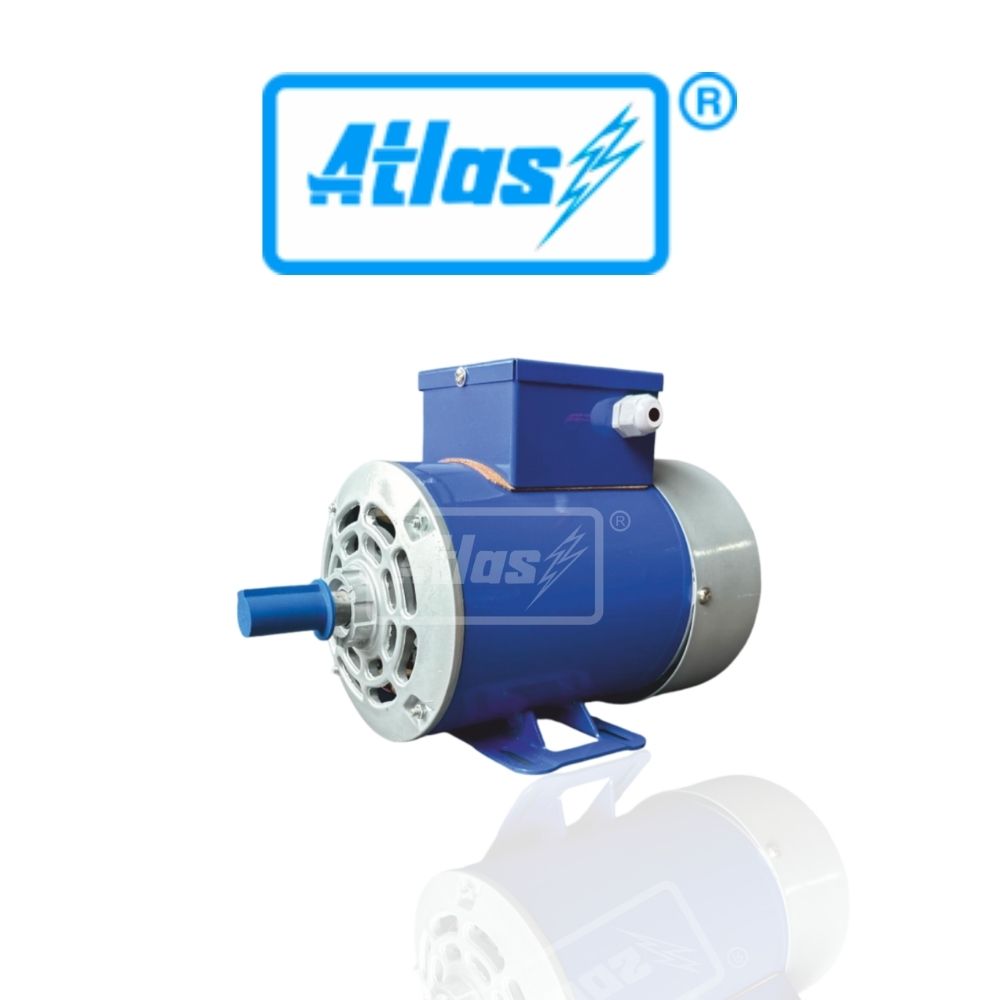
| Brand | Atlas |
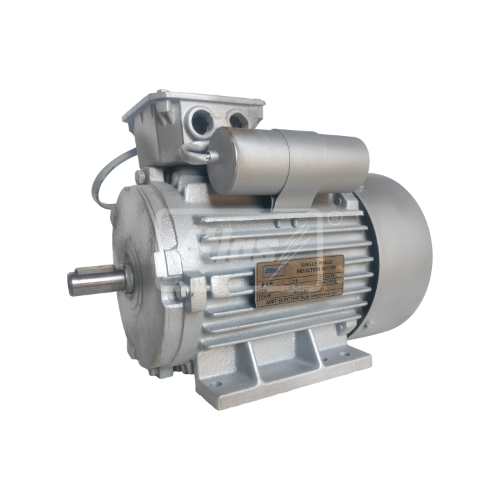
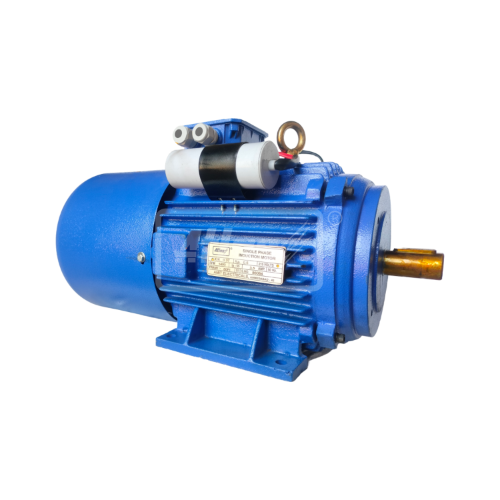
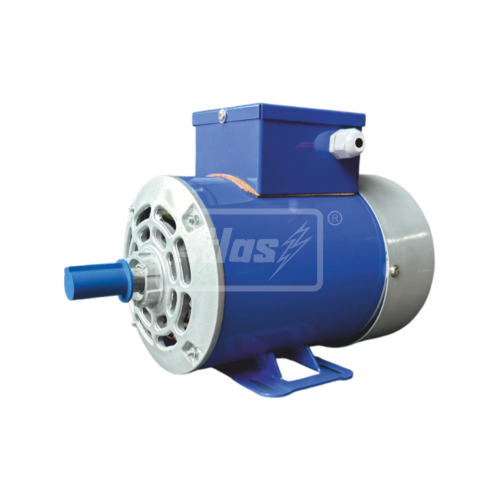
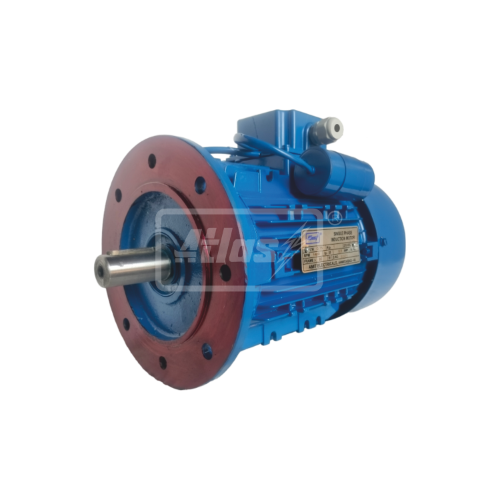
| Product | Single Phase AC Induction Motor |
| Range of Production | Single phase Motor Manufacturing from 0.1 to 3 H.p. (0.075 to 2.2 K.W.) Frame 63 to 112M in 2 & 4, Pole |
| Mounting Type | Foot (B3) Flange (B5) Face (B14) Foot with Flange (B35) Foot with Face (B34) |
| Frame | Robust, rugged cast iron frame with integral feet, optional aluminum body up to 100L frame |
| Voltage and Frequency | 220 ± 5% V, 50 Hz ± 3% Also available in 110V, 60Hz |
| Insulation | Class F insulation (Class H available on request) |
| Protection | IP44 as standard, can be supplied with IP-54 or IP-55 on request. |
| Shaft Direction | Clockwise rotation (reversible single-phase motor available) |
| Centrifugal Switch | Centrifugal mechanism disconnects the starting winding when the rotor reaches the predetermined speed and reconnects it when speed falls below it. |
| Winding Design | Capacitor start induction run motors with high starting torques for machine tools, small compressors, booster pumps, atta chakkis, etc. Resistant start induction run motors with moderately high starting torques for commercial juicers, industrial sewing machines, surgical pumps, etc. |
| Shaft & Rotor | Shaft key joint for positive locking, En-8/En-9 material shafts, high-pressure E.C. Grade aluminum die-cast rotor, dynamically balanced to reduce vibration and noise. |
| Bearings & Lubrication | C3 ball bearings, fully lubricated with lithium-based high-temperature grease up to 150°C. |
| Enclosure | Totally Enclosed Fan Cooling (T.E.F.C.) |
| Thermal Overload Protection | Available on demand for extra protection against overload. |
| Terminal Box | Standard terminal box on top position for foot-mounted (B3), left or right position available on request. |
| Earthing Terminals | Minimum two earthing terminals (one in the terminal box and one on the foot). |
| Paint | Semi-gloss synthetic enamel paint, special paint available on request. |
| Features | High efficient Noise free Vibration free Low running cost Durable Smooth finishing Cost-effective Precision design |
Atlas Electricals is a trusted Single Phase Motor Manufacturer and Supplier in Ahmedabad, Gujarat, India, offering reliable and efficiently designed single phase motors for a wide range of industrial, commercial and machinery applications. Our motors are engineered for smooth operation, dependable performance, long service life and easy maintenance.
Our Single Phase Motors are suitable for applications where a single-phase power supply is available. These motors are available in different configurations, mounting options and specifications to meet the requirements of various machines and equipment.
High-Performance Single Phase Motors
Atlas Single Phase Motors are manufactured with robust construction and precision engineering to provide consistent performance under demanding operating conditions. The motors are designed with quality components, dynamically balanced rotors and reliable bearing systems to help reduce vibration, noise and maintenance requirements.
Single Phase Motor: Complete Guide to Working, Types & Applications
Single-phase motors are everywhere—from ceiling fans to refrigerators and pumps. Despite their compact build and simple construction, these motors are engineering marvels in how they handle single-phase power to deliver rotation and torque. But how exactly do they work, and why do they need a little help getting started?
Let’s explore the engineering behind single-phase motors, their main types, and why they continue to be widely used in homes and light industrial applications.
What Is a Single Phase Motor?
A single phase motor is an electric motor that runs on single-phase AC power. Unlike three-phase motors, which create a naturally rotating magnetic field, a single-phase motor produces a pulsating magnetic field. That’s why these motors are not self-starting—they require an auxiliary mechanism to begin rotation.
Why Single Phase Motors Need Help Starting
At the core of the motor lies a stator coil energized by single-phase AC. This results in a non-rotating, alternating magnetic field. You can think of it as two opposing magnetic vectors (phasors) that cancel each other out at certain intervals.
- At 0° and 180°, the vectors align in one direction.
- At ±90°, they cancel out.
- The net result: no starting torque.
However, once the rotor is manually spun or assisted by a starting mechanism, the motor picks up and builds torque in one direction.
Key Components of a Single Phase Motor
- Stator – Contains the main and auxiliary windings.
- Rotor – Usually a squirrel-cage type made of laminated steel and conductive bars.
- Capacitor or Resistor – Used for phase-shifting in auxiliary windings.
- Centrifugal Switch – Disconnects auxiliary winding after startup.
Types of Single Phase Motors
Understanding the types helps explain how engineers overcome the single-phase starting challenge.
1. Resistance Split-Phase Motor
A resistance split-phase motor uses an auxiliary winding made of thinner wire and higher resistance. This creates a phase difference of around 30°, which produces enough starting torque for light loads.
- No capacitor needed
- Moderate starting torque
- Centrifugal switch disconnects auxiliary winding after reaching ~75% of full speed
Ideal for: Fans, washing machines, blowers
2. Capacitor-Start Induction Motor
Here, a large electrolytic capacitor is connected in series with the auxiliary winding for strong starting torque. Once the motor reaches speed, a centrifugal switch disconnects the capacitor.
- High starting torque
- Handles heavier loads
- Auxiliary winding is better insulated
Ideal for: Air compressors, pumps, heavy-duty appliances
3. Permanent Split Capacitor (PSC) Motor
A PSC motor has a smaller capacitor permanently connected in series with the auxiliary winding. There’s no centrifugal switch involved.
- Quiet operation
- Lower torque compared to capacitor-start
- Easy to reverse direction
Ideal for: HVAC systems, fans, blowers
4. Capacitor-Start Capacitor-Run Motor
This is a hybrid design that uses two capacitors: one for starting and one for continuous running. The result is improved performance during startup and steady operation.
- Balanced performance
- Lower running losses
- Greater efficiency at higher loads
Ideal for: Refrigeration, air conditioning units, conveyors
5. Shaded Pole Motor
This is the simplest type, using a copper ring (shading coil) to create a weak rotating magnetic field.
- No capacitor or centrifugal switch
- Very low torque
- Quiet and compact
Ideal for: Small fans, record players, toys
Power Factor and Efficiency in Single Phase Motors
Single-phase motors are generally less efficient than their three-phase counterparts. They draw more current and have a lower power factor, especially under partial load.
Frank Nola, a NASA engineer, proposed a power factor corrector (PFC) that lowers input voltage when the motor is lightly loaded, reducing losses and improving efficiency.
- Motors under 25% load benefit the most
- Effective for long-running or idle machinery
- Cannot be used on fully-loaded motors
Applications of Single Phase Motors
Single-phase induction motors are ideal where three-phase power isn’t available or practical. Common applications include:
- Household appliances (refrigerators, fans, washing machines)
- Office equipment (printers, scanners)
- Small industrial tools (drills, lathes)
- HVAC systems (blowers, exhaust fans)
For applications that require controlled stopping and starting under load, check out our Crane Duty Brake Motor options designed for high-performance lifting equipment.
Advantages and Limitations
Advantages
- Operates on readily available single-phase power
- Simple construction and low maintenance
- Cost-effective for small-scale applications
Limitations
- Not self-starting
- Lower efficiency
- Limited to lower horsepower ratings
Summary: Key Takeaways on Single Phase Motors
- A single phase motor needs external help (auxiliary winding or capacitor) to start.
- Multiple designs like capacitor-start, PSC, and split-phase motors tackle the starting problem in different ways.
- While they are less efficient than three-phase motors, single-phase motors remain vital in domestic and light-duty applications.
With smart improvements like PFC controllers, these motors can be optimized for energy savings, especially under low load conditions.
Single-phase motors continue to be a preferred choice for both home and light-industrial applications, and their performance quality often depends on the expertise of electric motor manufacturers who design and refine these systems for durability, efficiency, and consistent output. These manufacturers play a crucial role in improving winding design, capacitor selection, startup mechanisms, and motor efficiency standards—helping users get reliable motors that match diverse load requirements. Adding this perspective helps buyers understand how engineering and manufacturing standards influence the long-term performance of single-phase motors across different industries.
FAQ's
Why won’t my single phase motor start on its own?
Single phase motors aren’t self-starting because they produce a pulsating, not rotating, magnetic field. They need a starting mechanism like a capacitor or auxiliary winding to begin rotation.
Which type of single phase motor is suitable for industrial use?
Capacitor-start and capacitor-run motors are ideal for industrial use where higher starting torque and efficiency are required, such as pumps, compressors, and conveyors.
What’s the benefit of using a capacitor in a single phase motor?
Capacitors help generate a phase difference in the winding currents, creating starting torque. They also improve running efficiency and reduce noise in some motor types.